Online Movies
Nature Reviews Methods Primers

(under review)

Synthetic spatio-temporal datacube

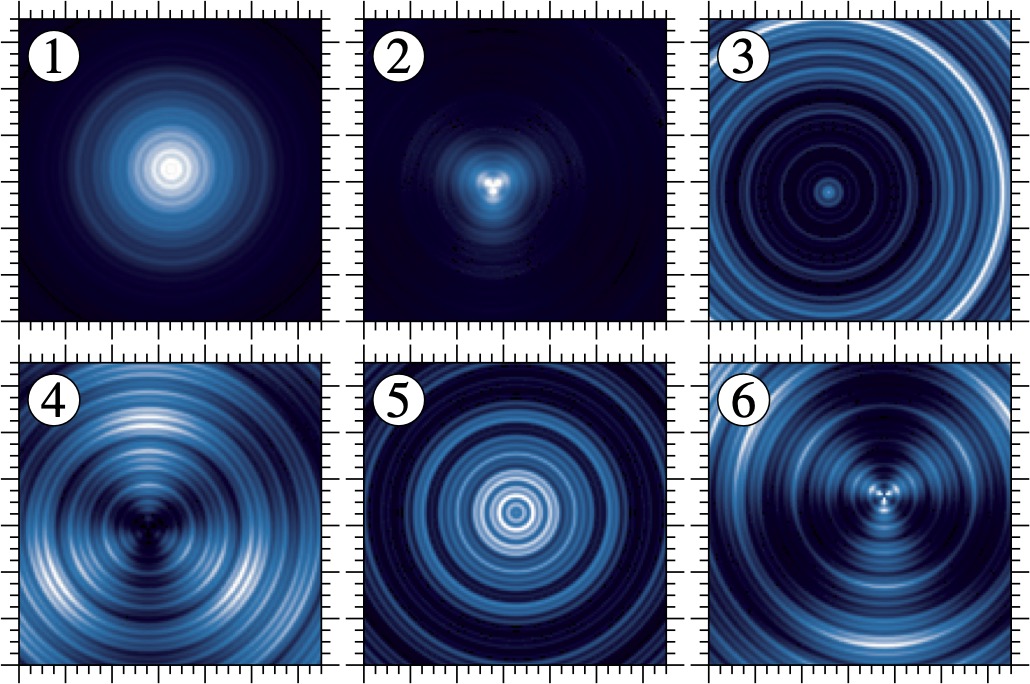
To simulate the complexities of wave phenomena across various scientific fields, we generate a synthetic spatiotemporal datacube. This datacube comprises 200 frames, each with a resolution of 130x130 pixels2, representing a time span and cadence of 99.5 and 0.5 seconds, respectively. The core structure of the datacube consists of 50 concentric circular regions. The radii of these regions decrease successively by 2 pixels, with the outermost circle having a radius of 100 pixels. Within each region, the sinusoidal waves are constructed using a predefined set of ten distinct frequencies, amplitudes, and phases, which are dynamically selected for each region based on its index. To further enhance the complexity, we superimpose several additional features:

Transient Polynomial Signal: A transient signal following a cubic polynomial function, with coefficients [0.01, -0.02, 0.03], is introduced, adding a time-evolving component to the datacube.

Transverse Motion: A simulated transverse motion, with different frequencies and amplitudes in x and y directions, is applied, mimicking the displacement of wave patterns across the spatial domain.

Fluting Mode: A fluting-like instability (with a wavenumber equal to 3) is incorporated, creating a characteristic deformation in the wave patterns.

Quasi-Periodic Signature: A quasi-periodic signal is also added to the datacube.
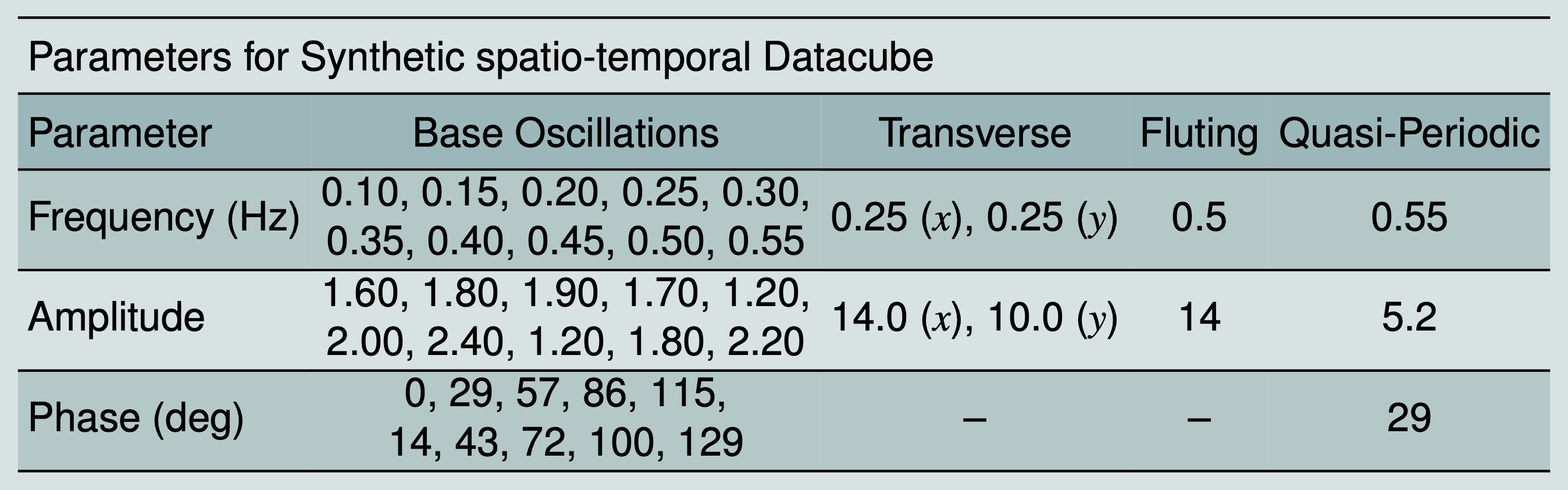
These diverse features, along with added noise, allow us to thoroughly analyze wave parameters and their spatial-temporal distributions. The parameters used to create the datacube are listed in the table below, and six consecutive snapshots are provided to illustrate the temporal evolution of the wave patterns.