
We are grateful to a total of 811 votes from 18 countries, resulting in the selection of the cover art image. The world heat map below illustrates a geographical distribution of all individual votes.
A composition of all images along with their brief descriptions are summarised below. The images, arranged in a random order, show real observations, simulations, as well as artistic impressions of the Sun's lower atmosphere.
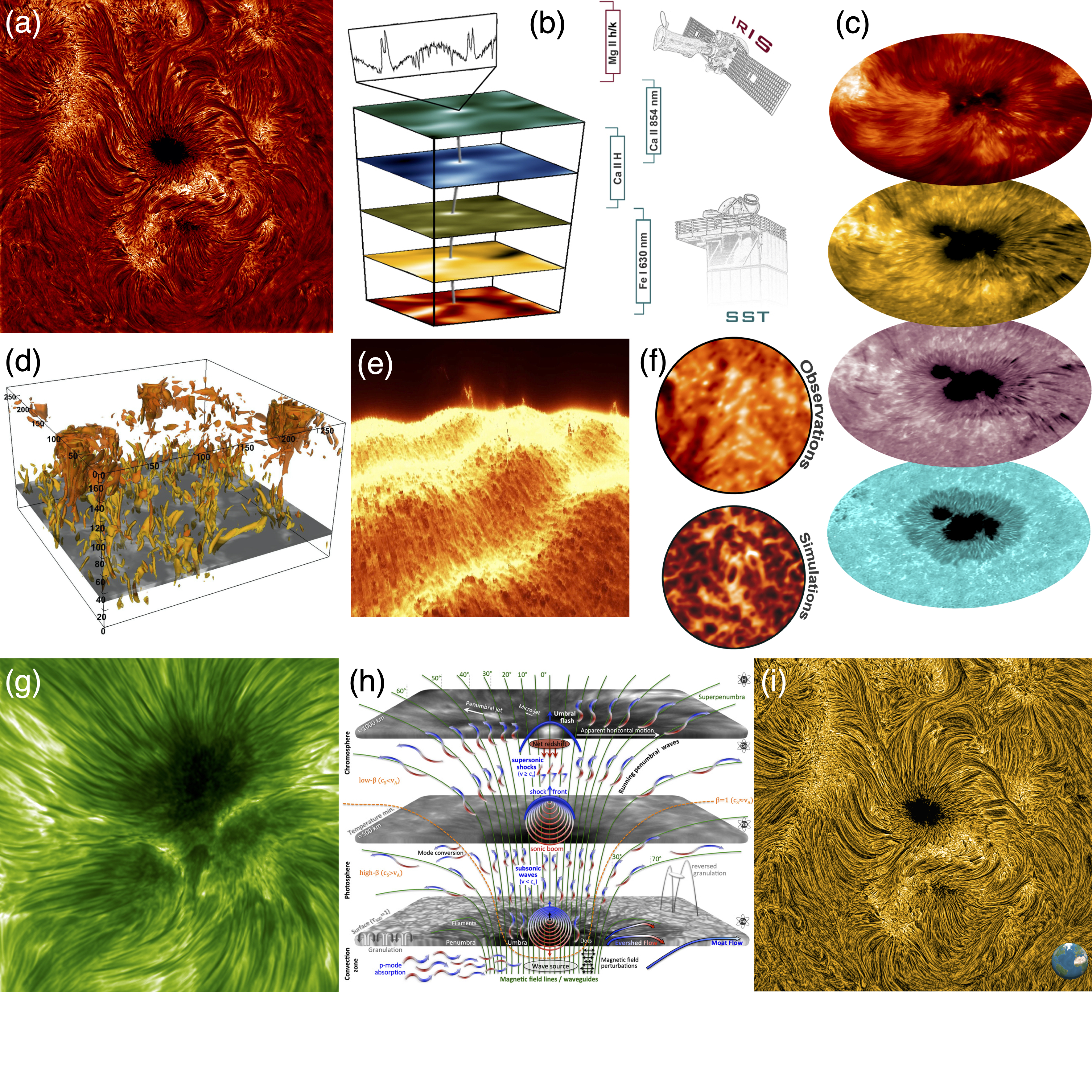
A highly magnetic active region in the Sun's chromosphere: Image of a highly magnetic active region as captured in the chromospheric H-alpha line (656.3 nanometers) by the HARDcam instrument at the Dunn Solar Telescope in New Mexico, USA. The dark sunspot umbra towards the centre of the field-of-view reveals much cooler material as a result of the strong magnetic fields inhibiting the convective mixing of the surrounding plasma. Sunspots play a pivotal role in the guiding of wave motion due to their concentrated magnetic fields. Image Credit: David Jess
MHD waves in a small magnetic structure: Multi-layer observations of a small-scale magnetic element through the lower solar atmosphere with the Swedish 1-m Solar Telescope (SST) and Interface Region Imaging Spectrograph (IRIS) explorer. For better visibility, the 3D cube has been stretched in height. Swaying motion of the flux tube (due to propagation of MHD transverse waves) and heating signatures (diagnosed as enhanced emission cores in the IRIS Mg II k spectra) are evident. Image Credit: RoCS/Shahin Jafarzadeh
Multi-layer observations of a sunspot at high resolution: A stack of sunspot images captured in the Calcium spectral line at 854.2 nanometers by the IBIS spectral imaging instrument at the Dunn Solar Telescope in New Mexico, USA. The blue, purple, yellow, and red coloured images sample different parts of the Calcium spectral line and reveal the structuring of the sunspot atmosphere from the photosphere (blue) through to the upper chromosphere (red). The dark sunspot umbra towards the centre of the field-of-view reveals much cooler material as a result of the strong magnetic fields inhibiting the convective mixing of the surrounding plasma. Sunspots play a pivotal role in the guiding of wave motion due to their concentrated magnetic fields. Image Credit: David Jess
A three-dimensional simulation of the lower solar atmosphere: Three-dimensional rendering of the vorticity channels in simulations of solar magneto-convection. Vorticity channels associated with the presence of magnetic flux tubes are highlighted in orange. The grey scale image at the bottom indicates the temperature below the surface. Image Credit: Elena Khomenko
An artistic impression of waves in the Sun’s atmosphere: A powerful shader lab in the Unity game engine was used to synthesise the Sun's surface. With DirectX libraries and GPUs it was possible to create the desired wave-like effects to resemble motion in the Sun’s atmosphere. For more information see this video. Image Credit: Adam Bielecki (suggested by Robert Sych)
The Sun's chromosphere at millimetre wavelengths: The image illustrates the solar chromosphere at around 1.2 mm wavelength from observations with the Atacama Large Millimeter/submillimeter Array (ALMA; top panel) and from realistic three-dimensional radiation magnetohydrodynamic simulations with the Bifrost code (bottom panel). Various types of waves and oscillations have been observed in these observations and simulations at different spatial scales. Image Credit: SolarALMA/RoCS/University of Oslo
Chromosphere of a sunspot at high resolution: Sunspots are large patches of magnetic field that appear prominently on the Sun’s surface (photosphere). The image shows the chromosphere of a sunspot, revealing how the magnetic field also shapes the upper layers of the Sun’s atmosphere, providing the hair-like structures called fibrils. The image is from a Calcium spectral line (854.2 nanometers) observed with the Swedish Solar Telescope by Vasco Henriques and produced by Richard Morton. Image Credit: Richard Morton
Sketch of sunspot dynamics and wave propagation: Wave dynamics in a sunspot, observed with the ground-based Dunn Solar Telescope in New Mexico, has been illustrated. The simultaneous scanning of multiple spectral lines in the visible to near-infrared range has allowed a fine sampling of the photosphere and chromosphere above the sunspot. Sunspot waves are detected throughout all atmospheric layers, from the lower photosphere to the upper transition region and corona. Umbral flashes and running penumbral waves are most prominent in the sunspot chromosphere. All oscillations in spectral intensity and Doppler velocity occur unceasingly at periods of a few minutes for the observational timespan. The most likely driving mechanism is the absorption of p-modes by the sunspot in the upper convection zone and lower photosphere. Magnetoacoustic waves are also driven by perturbations of the magnetic field lines. See PhD thesis of Johannes Löhner-Böttcher for further information Image Credit: Johannes Löhner-Böttcher
Chromosphere of a highly magnetic active region: Image of a highly magnetic active region as captured in the chromospheric H-alpha line (656.3 nanometers) by the HARDcam instrument at the Dunn Solar Telescope in New Mexico, USA. The image has been sharpened through use of Multiscale Gaussian Normalisation, and a life-size representation of the Earth is depicted in the lower-right to provide a sense of scale. The dark sunspot umbra towards the centre of the field-of-view reveals much cooler material as a result of the strong magnetic fields inhibiting the convective mixing of the surrounding plasma. Sunspots play a pivotal role in the guiding of wave motion due to their concentrated magnetic fields. Image Credit: David Jess